 Lake Country Edition
A Fish Oil You Keep in the Refrigerator, Shake Well and Take With Supper
Omega-3 Power Squeeze is an orange-flavored fish oil whose label asks for the cold, a shake, a meal and thirty days once opened. I kept it that way for a month, the spoon beside my supper plate.

This is a paid advertisement. Sponsored by BrainMD.

Miles Pardon is the pen name of this desk.
Everything on this page about the bottle comes from the seller's own label, product page and posted policies, read on September 21, 2026.
The three customers quoted further down are real, and their reviews are public on the seller's site.
The small photographs beside them are illustrations, not the reviewers.
On the back of this bottle, under the panel, there is one short line that tells you how to live with it.
It reads: "Take 1 tablespoon (15 ml) daily with food."
Then: "Shake well before use."
And last: "Refrigerate after opening and use within 30 days."
That is four instructions and a clock, and it is the line most people read last.
I read it first, because up here the refrigerator is where we keep things that spoil, and I wanted to know why a fish oil had moved in beside the milk.
I live on a lake where the ice goes out in late April and comes back the week before Thanksgiving.
Most of my life has been spent around fish that were alive that morning.
So I have a plain view of fish oil.
It is a food, it turns if you mistreat it, and a man can smell the difference from across the kitchen.
For years I kept a jar of fish oil capsules in the cupboard above the stove, because that is where my wife kept the vitamins.
The cupboard above the stove is the warmest cupboard in the house, and it was the worst place in the house for that jar.
This bottle is different, and its own label says so.
It is sold like a pantry item and asks to be kept like a carton of milk.
That one fact changes how you buy it, where it lives, when you take it and how fast you have to finish it.
None of that is on the front of the box.
The whole page hangs on one line from the back label.
Here is the plan.
I am going to read that line one instruction at a time, then put a tablespoon of this beside the fish I actually eat, then go through what the trials found at this amount, and then tell you plainly who I think should buy a bottle.
The bottle is called Omega-3 Power Squeeze, and it is sold by BrainMD, a supplement company in Irvine, California.
I will set it on the table properly once its label has had its say, because the label is the better introduction.
The oil is pressed from anchovy, sardine and mackerel.
That makes this a fish product first and a supplement second, and the rest of the page reads it that way.
If you have a fish allergy, this is where the page ends for you, because there is no version of this bottle that is not fish.
One Line on the Back Label, and Four Instructions Inside It
Labels are written by lawyers and chemists, and the usage line is usually where the chemist gets the last word.
This one is short enough to take apart on a kitchen table.
"Take 1 tablespoon (15 ml) daily."
That is the dose, stated in a unit you already own, and it is the same tablespoon the panel lists as one serving.
The panel weighs that spoonful at 15.9 grams, while the usage line calls it 15 milliliters.
There is no contradiction in that: an emulsion of fish oil, water and gums is a little heavier than water, so a level tablespoon of it weighs a little more than fifteen grams.
"With food."
That is a request about timing, and I will give it a section of its own, because it is the instruction most people drop first.
"Shake well before use."
That is a confession about what is in the bottle, and it is an honest one.
"Refrigerate after opening and use within 30 days."
That is the one that changes everything, because it puts a clock on a bottle that most people handle as if it had none.
Put those four together and you get a picture of the product that no photograph on the seller's page gives you.
This is a perishable food in a squeeze bottle, closer to a jar of mayonnaise than to a tin of capsules.
I do not say that as a complaint.
Most of the good things in my refrigerator are there because they would spoil anywhere else.

Mine lives on the top shelf at the back, next to the milk.
The door shelves swing warm every time somebody goes looking for the ketchup, and a fish oil has no business being swung.
One tablespoon a day, with a meal, shaken first, kept cold once open, finished within thirty days. That is the whole label in one line.
Why an Emulsion Needs a Good Shake Before Every Spoon
Oil and water do not want to stay together.
Every cook in the north knows this from the first time he made a vinaigrette for a fish fry and watched it split on the table.
To turn a fish oil into something you can eat off a spoon, a maker breaks the oil into tiny droplets and suspends them in water.
Then he adds something to keep the droplets apart, which on this panel is gum arabic, xanthan gum and guar gum.
Those three are ordinary thickeners.
You will find the same names on a bottle of salad dressing or a tub of ice cream in any grocery on the county road.
Glycerine is on the panel too, for body and a little sweetness.
None of it is exotic, and none of it is doing anything for your memory; its job is to hold the fish oil in suspension long enough for you to eat it.
But an emulsion is a truce, not a peace treaty.
Given time and a cold shelf, the heavier and lighter parts drift, and the top of the bottle is not quite the same as the bottom.
That is why the label says to shake it, and why I shake it hard.
Four firm shakes, cap closed, before every spoonful, is the cheapest way to make sure the spoon holds what the panel says it holds.
Think about what happens if you skip the shake for a month.
The first spoons might carry a little more of one part and the last spoons a little more of the other, and the panel's 1,500 milligrams become an average rather than a spoonful.
I have no measurement of how much that matters for this bottle, and neither does anyone else in public.
I only know that the maker put the instruction on the label, and that makers do not add words to a label they do not need.
There is a second reason the shake matters in a northern kitchen.
Cold thickens things, and a bottle that has been at the back of a refrigerator all night pours slower than the same bottle on a warm counter.
So I shake it, I squeeze slowly, and I let the spoon fill level before I lift it.
It takes perhaps fifteen seconds, and it is the most honest fifteen seconds of the whole routine.
Shake, squeeze slowly, fill the spoon level.
The Cold: What a Refrigerator Does for a Bottle of Fish Oil
Fish oil is made of long, bent fats with many soft places in them.
Those soft places are exactly what makes them interesting to your body, and exactly what makes them go off when they meet air, light and warmth.
Anyone who has left a fillet on the dock in August knows the smell of fish fat that has turned.
That smell is the oil reacting with the air, and a capsule jar in a warm cupboard can do a slower version of the same thing.
This maker has done three sensible things about it.
The bottle is opaque, so light stays out; the cap is a squeeze cap, so the bottle is never left open to the kitchen; and the panel carries an antioxidant blend to slow the whole business down.
The antioxidant blend is four ingredients doing one job.
Vitamin E as d-alpha tocopherol, rosemary extract, ascorbyl palmitate and green tea extract, all there to keep the oil fresh until the last spoon.
None of those four is listed with an amount, and that is as it should be.
They are preservation, not nutrition, the way the salt in a smoked fish is there to keep it and not to feed you.
I say this because vitamin E on a label makes people think of a dose.
In the Women's Health Study, 6,377 women aged 65 and over took 600 international units of vitamin E on alternate days for up to nine and a half years, with no benefit to their thinking. [1]
That is far more vitamin E than this bottle could carry, for far longer, and it did nothing measurable for the mind. [1]
The traces in this spoon are keeping the fish oil from turning, which is a real job and a different one.
The refrigerator is the fourth line of defense, and it is the one the maker hands to you.
Once the seal is off, air gets in every time you squeeze, and the cold slows everything that air starts.
I would add one household rule the label does not print.
If a spoonful ever smells sharp or painty rather than faintly of orange, I do not eat it, and I would not ask you to either.
Opaque bottle, squeeze cap, antioxidant blend, and then your refrigerator. The last one is the only part of the job the maker cannot do for you.
Thirty Days From the Seal, and Thirty Tablespoons in the Bottle
Now the arithmetic, which is where the refrigerator line gets interesting.
The panel says thirty servings to the bottle.
The usage line says to finish the bottle within thirty days of opening it.
Those two numbers are the same number, and that is not a coincidence.
The bottle is sized so that one tablespoon a day empties it on the last day the label allows.
That is tidy, and it has consequences worth thinking through before you open the first one.
If you skip days, the bottle outlives its window.
Miss one day a week and you will be holding four or five tablespoons on day thirty that the label says to throw out.
If you take half a tablespoon, the arithmetic gets worse.
Half a spoon a day means fifteen spoonfuls used in thirty days, and half a bottle left over when the clock runs out.
If you take it every other day, the result is the same as half a spoon.
Half the bottle, past its date, in the back of the refrigerator.
That last point matters for the man who reads a page like this one and decides to "go easy" and see how it goes.
With this bottle, going easy is the expensive way to take it.
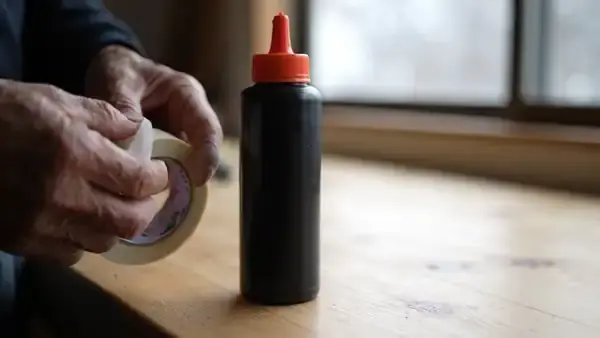
There is a small habit that solves most of this, and it costs one strip of masking tape.
On the day I break the seal, I put a strip of tape on the cap and write the date thirty days out.
It is what we do with a jar of pickled fish in this house, and it works for the same reason.
You never have to remember when you opened it, because the bottle tells you.
The seller's own page adds two things to the label's arithmetic, and I will give you both.
Its answers to common questions say the tablespoon can be divided into two or three portions across the day, and that adults may take two tablespoons daily, which it calls the maximum it recommends.
Divided portions still add up to one tablespoon a day, so the thirty-day arithmetic does not change.
Two tablespoons a day is a different bottle: it empties in fifteen days, and it doubles the amount to 3,000 milligrams of EPA plus DHA.
For the record, the federal guidance sits above both.
The Office of Dietary Supplements at the National Institutes of Health reports that the FDA recommends no more than five grams a day of EPA and DHA combined from dietary supplements. [2]
One tablespoon of this is a gram and a half.
This page stays with the one tablespoon on the label, and I would not go past it without asking the pharmacist first.
Thirty spoonfuls, thirty days from the seal. Skipping days or halving the spoon leaves bottle behind when the clock runs out.
The Drive to the Cabin, a Cooler and a Truck in July
There is one situation the label does not mention, and in lake country it comes up every summer weekend.
You open a bottle at home in town, and then you spend four days at the cabin, or a week at your brother's place on the other lake.
The label's instruction does not stop at the county line.
An opened bottle wants the cold, so it rides in the cooler with the bait and the bratwurst, not in the glove box.
I learned that the hard way with a jar of capsules years ago.
It spent a July afternoon on the dashboard of my truck while I fished, and by the end of the week the whole jar smelled like the bottom of a minnow bucket.
A squeeze bottle that has been opened is less forgiving than a sealed jar, because air has already been inside it.
So the rule I keep is simple: once opened, it travels the way the milk travels.
An unopened bottle is a different matter.
The label's refrigerator instruction begins "after opening," which I read as permission to keep a sealed spare in a cool cupboard, away from the stove and out of the sun.
That also answers a question I get from men who winter somewhere warmer.
If you are going to be away for more than a week, do not open a new bottle the day before you leave; open it when you arrive, and let the thirty days start there.
None of this is chemistry you need a degree for.
It is the same common sense every man up here already uses with a stringer of perch and a long drive home.
Once opened, it travels the way the milk travels.
With Food: Why the Label Puts the Spoon Beside a Meal
Now the instruction nobody follows, because a spoonful of something orange feels like it ought to go down standing at the counter.
The label says with food.
I take it to mean that, and I take it at supper, which up here is at half past five and nobody apologizes for it.
There are two plain reasons a fish oil belongs beside a meal.
The first is that fat is eaten with other food in every kitchen on earth, and your stomach is built for exactly that.
The second is the stomach itself.
The Office of Dietary Supplements lists the side effects of omega-3 supplements as usually mild: an unpleasant taste in the mouth, bad breath, indigestion, nausea, stomach discomfort, loose stools, headache and sweat that smells. [2]
Most of that list is the ordinary protest of an empty stomach meeting a spoonful of fat.
A spoon taken on its own at six in the morning is the likeliest way to meet one of those complaints, and a spoon taken with supper is the likeliest way to miss them.
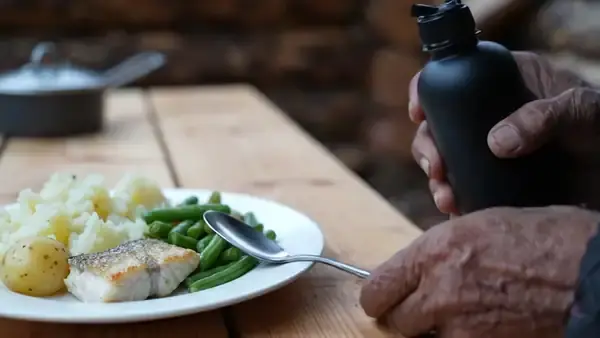
The seller's page says there are no burps and no fishy aftertaste, and I will be fair to it.
The reviews, which I come to later, mostly agree about the taste, and one of them says outright that this fish oil sits better than others did.
But the label's own instruction is the better guide.
A maker who writes "with food" on the back is telling you how to take it so that it agrees with you, whatever the front says.
There is a third, quieter reason to tie it to supper, and it has nothing to do with chemistry.
A spoon that belongs to a meal gets taken; a spoon that belongs to "sometime today" gets forgotten, and a forgotten spoon breaks the thirty-day arithmetic above.
One spoon, one meal, the same meal every day.
The Spoon Beside the Fish: What 1,500 Milligrams Looks Like on a Plate
Here is the section I most wanted to write, because nobody puts a fish oil beside the fish.
The National Institutes of Health keep a table of how much EPA and DHA sit in common foods, taken from the Department of Agriculture's food database. [3]
I put that table beside this tablespoon, one portion at a time, and the numbers are more useful than any adjective on the bottle.
Here is that table, one three-ounce cooked portion at a time.
- - Farmed Atlantic salmon: 1,830 mg of EPA plus DHA. The spoon is a little less than one portion. [3]
- - Atlantic herring: 1,710 mg. The spoon is again a little less than one portion. [3]
- - Sardines canned in tomato sauce, drained: 1,190 mg. The spoon is about one and a quarter portions. [3]
- - Atlantic mackerel: 1,020 mg. The spoon is about one and a half portions. [3]
- - Wild rainbow trout: 840 mg. The spoon is nearly two portions. [3]
- - Light tuna canned in water: 190 mg. The spoon is nearly eight portions. [3]
Read that list slowly, because it answers the question every man in a fishing town asks first.
One tablespoon of this carries about as much EPA and DHA as a three-ounce portion of salmon or herring.
Against the lake fish, it is more.
A wild rainbow trout from a cold stream is a lovely thing to eat, and three ounces of it holds a little over half of what this spoon holds. [3]
Against canned tuna, the comparison is not close.
Light tuna in water is lean fish, and you would need nearly eight three-ounce servings of it to match a single spoon. [3]

Now the week, because that is how most of us actually eat fish.
Seven spoons is 10,500 milligrams of EPA plus DHA, and two three-ounce portions of farmed salmon come to about 3,660.
So a daily spoon is not the same as two fish suppers a week.
It is nearly three times as much, which matters for anyone who assumes the bottle simply replaces the Friday fish fry.
The same federal table gives two more figures worth setting beside the spoon.
It says US adults get about 90 milligrams a day of EPA and DHA from food, and that a typical fish oil supplement provides 1,000 milligrams of fish oil with 180 of EPA and 120 of DHA. [3]
Against the average American plate, then, this spoon is about seventeen days of EPA and DHA in one swallow.
Against a typical fish oil capsule, it is the same as five of them.
I want to be careful with those numbers, because big numbers invite big conclusions.
More EPA and DHA in a spoon is a statement about fat, not about memory, and the trials further down are the only place the second question gets answered.

There is a comfortable truth sitting in that table for a man who likes to fish.
If you eat oily fish two or three times a week, you already have a good share of what this bottle sells, and it came with a supper.
And there is an uncomfortable one for the man who does not.
If your fish is a tuna sandwich twice a month, your plate holds almost none of it, and a spoon is the simplest way I know to change that number.
Neither of those truths tells you whether the number matters for your memory.
They only tell you where you stand before you decide.
One spoon is about one portion of salmon or herring, nearly two of rainbow trout, about eight of canned light tuna and five typical capsules. [3]
Why Small Fish, and What Becomes of the Mercury
The second question in a fishing town is always about mercury, and it deserves a straight answer.
The oil in this bottle is pressed from anchovy, sardine and mackerel.
Those are small, fast-growing, short-lived fish that sit low in the food chain, which is the reason fish-oil makers use them and nobody presses a walleye or a swordfish.

Here is what the Office of Dietary Supplements says about the metal.
Seafood contains varying levels of methylmercury, and omega-3 supplements have not been found to contain it, because it is removed during processing and purification. [3]
That is a statement about fish oil supplements as a class, not about this bottle in particular.
The seller's own page goes further and says its oil is tested by independent laboratories for more than 250 contaminants.
I did not find a certificate for this bottle linked from the page, so I will leave that sentence where I found it, as the seller's claim.
The class answer from the federal fact sheet is the one I would rest my own supper on.
The seller's page also says wild-caught.
That is fine as far as it goes, and it is worth noticing that the same federal table found farmed Atlantic salmon carries more EPA and DHA than most wild fish on the list, because it depends on what the fish were fed. [3]
Wild or farmed, the useful fact for your kitchen is the same.
Small fish, purified oil, and a label that names all three species, which is more than many fish oil bottles bother to do.
Three small fish, named on the label.
So the label has been read, the spoon has been set beside the fish, and the fish themselves have been accounted for.
Here, at last, is the bottle they end up in.
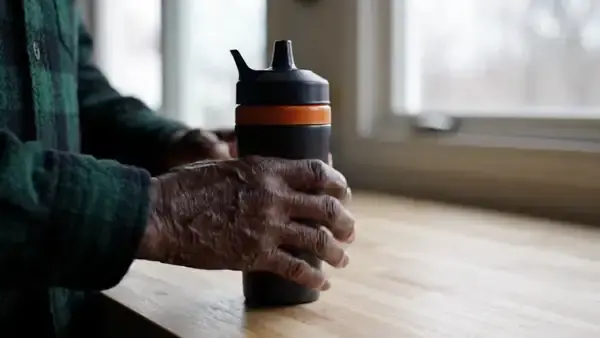
That is the whole object: one bottle, one month, one spoon a day.
The flavor on the label is Citrus Blast, and the seller's page calls it orange and vanilla, which is closer to what reaches your tongue.
You do not swallow a capsule, and you do not count drops.
You squeeze a spoonful out of the bottle, you eat it, and you put the bottle back in the cold.
What the Trials Found at This Amount, Set Out Plainly
Now the question the bottle is really bought for, and the part of this page I have tried hardest to keep honest.
One and a half grams of EPA plus DHA is not a small, untested dose.
It is a dose that has been given, and exceeded, in careful trials of people my age.
The largest reading is a 2012 Cochrane review, which pooled three randomized trials with 3,536 participants aged 60 and over. [4]
After 24 or 40 months, omega-3 supplements made no difference against placebo on a standard mental-status score. [4]
The same review found no benefit on word learning, on digit span or on verbal fluency. [4]
Those are the three things a man over sixty actually notices: a list someone read to you, a number held long enough to dial, and the word that will not come.
I am not going to turn that last finding into an alarm.
It is one result in one trial, and it was small, but it points the wrong way, and any page that quotes only the good news is selling rather than reporting.
Then the Swiss-led trial, the largest single study of the three.
Two thousand one hundred and fifty-seven adults aged 70 and over, without major health problems, took one gram of omega-3s a day, vitamin D, a strength program, or combinations of them, for three years. [6]
On the cognitive screening score, none of it moved: not the omega-3s alone, and not all three together. [6]
The caveats are that it used a screening test rather than a full battery, and that its people were healthy and active, which is to say they looked a great deal like the readers of this page.
There is one reading that points somewhere, and it would be dishonest to leave it out.
A 2015 meta-analysis found that DHA, alone or with EPA, improved episodic memory in adults with mild memory complaints, and that doses above one gram a day improved episodic memory whatever a person's starting score. [7]
Episodic memory is memory for events: where you left the truck keys, who was at the table on Sunday, what you did on Tuesday.
In that same analysis, working memory and semantic memory did not differ between the groups at all. [7]
This spoon clears the one-gram bar with room to spare.
The stronger half of that finding, though, was in people who already noticed their memory slipping, and most men who read a page like this are somewhere between fine and wondering.
Then there is the single two-year trial in this whole file that came out positive, and what went into it matters.
Sixty healthy adults aged 65 and over took one gram of fish oil a day together with 22 milligrams of carotenoids and 15 milligrams of vitamin E, and made fewer errors on working-memory tasks than placebo, with small effects that grew as the tasks got harder. [8]
That fish oil held 430 milligrams of DHA and 90 of EPA, less than this spoon on both counts. [8]
So the one positive trial used less fish oil than this bottle, plus two other nutrients this bottle does not contain.
The carotenoids in it are lutein and zeaxanthin, the yellow pigments of egg yolk, sweet corn and dark greens.
Two one-year trials in older adults found 12 milligrams a day of them went with better complex attention in one and appeared to buffer slippage on a verbal learning task in the other. [9] [10]
Both were small and both measured particular tasks.
They are still more encouraging than anything in the fish-oil file, and the foods that carry those pigments are on every farm-stand table in August.
And the tidy ending belongs to a 2018 systematic review of 51 trials. [11]
It concluded that it is still unclear whether long-chain omega-3s improve thinking in younger or older adults. [11]
Fifty-one trials, and the answer is still unclear.
If the effect were large, fifty-one trials would have found it; if there is one, it is small and slow, which is exactly what you would expect of a food.
Three large readings at or above this dose found nothing in healthy older adults. [4] [5] [6] One pooled reading found a narrow signal in episodic memory. [7] Fifty-one trials leave the question open. [11]

A Blood Test the Seller Mentions, and What It Can Tell You
The seller's own answers to common questions make a suggestion I have not seen on many fish oil pages.
They say that people absorb EPA and DHA differently, and that it would be prudent to measure something called the Omega-3 Index every five or six months.
I looked into what that test is, because it is the one thing on this whole subject a man can actually measure.
The Office of Dietary Supplements describes it as the share of EPA plus DHA in the fatty acids of your red blood cells, a figure that reflects what you ate over roughly the previous 120 days. [3]
It also says that in Western populations who eat little fish, that share typically sits at about 3 to 5 percent. [3]
And it notes, plainly, that most clinicians do not assess omega-3 status at all. [3]
Now the useful part.
The same fact sheet says that every supplement form of omega-3s significantly raises the EPA and DHA in the blood. [3]
So a month of these spoons will very likely move a number in your blood.
What that number cannot tell you is anything about your memory, because a blood test measures fat and not recall.
The seller's page ties its suggested target to a threshold that belongs to another conversation entirely, not to thinking.
I have left that threshold off this page on purpose, because a target for one part of the body is not evidence for another.
If you are the kind of man who likes a number on paper for his own records, the test exists and your clinician can tell you whether it is worth ordering.
Just go in knowing what it measures, and do not let a better blood number stand in for a better Tuesday.
Why It Has to Be Fish, and Not the Seed Oils on the Same Shelf
A fair question at this point is why anyone bothers with fish at all, when the grocery shelf is full of flax and chia.
The answer is a matter of what the body can build.
Plant foods carry a shorter omega-3 called ALA, and the Office of Dietary Supplements reports that the body's conversion of it into EPA and DHA is very limited, at reported rates under 15 percent. [3]
One small trial shows the shape of it neatly.
Eighty-eight healthy adults took up to 9.7 milliliters a day of a seed oil rich in plant omega-3s for twenty-eight days, and their EPA rose with the dose while their DHA did not rise at all. [12]

DHA is the structural one, the fat built into the membranes of nerve cells, and it is the one the big trials above were mostly testing.
So if DHA is what you are after, it comes from fish, or from the algae the fish ate, and not from a spoonful of seeds.
That is not a reason to buy this bottle.
It is the reason a plate of sardines is on the shortlist and a sprinkle of flaxseed on your oatmeal is not, whatever else flaxseed is good for.
Four Grams of Xylitol, and a Dog Who Knows the Sound of the Refrigerator
Now the one real hazard on this panel, and it is not a hazard to you.
The label says no sugar, and that is accurate: zero grams of sugars.
The sweetness comes from four grams of xylitol per tablespoon, a sugar alcohol, which is a different sentence from the one a shopper hears.
For a man, four grams is a small amount, well short of what upsets most stomachs.
For a dog, it is another matter entirely.
The Food and Drug Administration publishes a consumer notice about it.
It says xylitol is absorbed quickly in dogs and can set off a strong release of insulin and a rapid, deep drop in a dog's glucose within ten to sixty minutes, while in people it does not stimulate insulin. [13]
The same notice lists where xylitol turns up: gum without sugar, candy, baked goods, toothpaste, mouthwash, vitamins and dietary supplements. [13]
A bottle of something that smells faintly of fish and orange is exactly the kind of thing a dog will take an interest in.

Here is where the refrigerator helps, and where it does not.
A bottle in a closed refrigerator is out of reach, but the door opens a dozen times a day, and every dog in the north knows the sound of it.
So the bottle goes on the top shelf at the back, cap closed, and the spoon goes straight into the sink with water in it.
That is the whole of the caution, and it is a caution about your kitchen rather than about you.
If you keep a dog who stands at the refrigerator whenever it opens, you already know which one I mean.
Take the spoonful at the table, not on the floor-level shelf of the door, and never leave the bottle out on the counter to warm up.
Four grams of xylitol a spoon: nothing much for a man, a genuine hazard for a dog. [13] Top shelf, cap closed, spoon in the sink.
The Taste, Cold, and Three Customers Who Wrote About It
The seller's page carries 325 reviews averaging 4.85 stars.
I read a good share of them with a pencil, because a star average tells you almost nothing on its own.
Here is what they are about.
Nearly all of them are about taste, texture and the absence of a fishy aftertaste, and almost none of them are about memory.
That is the most useful thing I learned from them.
Taste is the variable that decides whether a bottle is finished in thirty days or left behind the pickles, and with this bottle, finishing it in thirty days is the whole point.
Cold changes the taste, by the way, and in this bottle's favor.
A spoonful from the back of the refrigerator is thicker and quieter than one from a warm counter, the way a cold glass of milk tastes of less than a warm one.
A good share of the reviews are written by parents about children, because this is a household product as much as a man's product.
I left those aside, along with any review that made a claim the label does not make, and kept three about taste and digestion, one of them at four stars rather than five.
The photographs beside them are illustrations, not the people who wrote them.

This form of Omega 3 is palatable, fresh, tasty and has no fish scent. The dark bottle protects the liquid from sunlight. Easy to squeeze the right amount, easy to taste and swallow.

I've tried several omega supplements over the years, and this is the only one I've actually enjoyed taking. The squeeze tastes great with no fishy aftertaste and I've been able to use it consistently.

I like this product because other fish oils do not agree with my system. I can digest this one. There is no fishy taste.
Notice what none of the three claims.
Not one of them says it did anything for their memory, and I would not have printed it if it had.
Notice also that the first one mentions the dark bottle, and the second one the word "consistently."
Those are the two things this page has been about: a fish oil kept away from light and air, and a spoon that actually gets taken every day.
And the third one is the most useful of all for a man who gave up on fish oil once already.
She is saying other fish oils disagreed with her and this one did not, which fits the label's own "with food" and fits the federal list of what omega-3 supplements usually do to a stomach. [2]
The real product here is a fish oil you will actually finish.
What the Seller's Page Promises, and What This Page Leaves Out
Every bottle comes with a front and a back, and on this one the back is the better read.
The seller's page says the emulsion gives up to three times better absorption.
I found no study cited for that sentence anywhere on the page, so I read it as a claim and not a finding.
It is not an unreasonable claim on its face, because emulsified fats are broken up before you eat them.
But "up to" is doing a great deal of work in that sentence, and a number with no paper behind it is not something I would pay extra for.
The seller's page also sets out a week-by-week calendar of what customers may notice in the first days, weeks and months.
No study is cited for that calendar either, and the trials above, which ran for months and years, do not support expecting anything in particular from a first month.
The brand name carries the name and medical credential of the man who founded the company.
This page does not use either one as an argument, and you will not find that name anywhere on it.
A credential on a label is not evidence about a bottle.
The trials are evidence, and they are the reason this page reads as it does.
Here is what I would keep from the seller's page, because it is useful and checkable.
The panel matches the front of the label to the milligram, 910 plus 590 making exactly 1,500; the species of fish are named; and the usage line is honest about the cold and the clock.
- It will not come with a trial of itself. Nobody has tested this bottle; the trials tested fish oil at measured doses in other people.
- It will not do what the large trials could not. At this dose and above, in healthy adults over 60, 65 and 70, they found nothing. [4] [5] [6]
- It will not keep on a warm shelf once opened. The label asks for the refrigerator and a thirty-day finish.
- It will not act on anything a clinician has named. It is a dietary supplement, and its own label says so.
- It will not replace fish on your plate. It carries the same fats without the rest of the supper.
Sixty Days to Return It, Thirty Days to Finish It
The seller posts a sixty-day return policy, and it reads differently once you know about the refrigerator line.
Inside sixty days, an unopened bottle earns the price of the product back, less what you paid for shipping.
An opened bottle earns store credit up to the original amount rather than money back to your card, and the postage to send either one back is yours.
Now set that beside the label.
An opened bottle has thirty days of life by its own instructions and sixty days of return window by the seller's policy.
So if you open it, dislike it and wait, you will be returning a bottle the label says to have thrown out a month earlier.
Decide within the first week, while the bottle is still fresh and nearly full.
And be realistic about what the policy is good for.
It is good protection against a bottle that arrives damaged, leaking or wrong, and it is not a taste test with a refund at the end, because breaking the seal moves you from refund to credit.
If the taste is your real worry, there is a cheaper way to settle it.
Eat a tin of sardines on rye this week, and if you cannot face that, you are unlikely to face thirty spoonfuls of anchovy oil either.

Unopened within sixty days: the product price back, less shipping, and opened: store credit. Postage back is yours, and an opened bottle is due to be finished in thirty days anyway.
What Belongs on the Table Anyway, Whatever Is in the Refrigerator
This is the section I would keep if I had to throw the rest away.
Start with the obvious one, because it is the same fat in its original container.
If you eat oily fish twice a week, the table above shows you already carry a good share of what this spoon sells, and you got supper with it. [3]
Fish is also part of the one eating pattern that has been through a proper trial for thinking.
In a three-year trial of 604 older adults, one group ate the MIND pattern of vegetables, berries, nuts, whole grains, beans, fish and olive oil, and the other ate its usual food with slightly fewer calories. [14]
Both groups improved their scores, by about the same amount. [14]
That is duller than the diet's reputation and more useful than anything in a bottle, because it suggests that paying attention to what you eat at all did something.

Then the glass beside the plate.
In 550 British civil servants followed for thirty years, the more a person drank, the faster their word-fluency scores fell, and light drinkers had no edge over those who did not drink at all. [15]
There was no protected middle ground in that study: less was better all the way down. [15]
In lake country, where the evening beer on the dock is practically a sacrament, that is a hard sentence and an honest one.
Then the shelf of packaged food.
In a Brazilian study of 10,775 adults followed for a median of eight years, those who ate the most ultra-processed food slipped on tests of thinking about a quarter faster than those who ate the least. [16]
That is an association across a population, not a verdict on your breakfast.
It is still more useful than any single food rule, because it describes a pattern you can change one shopping trip at a time.
Eggs, milk, meat and beans carry choline, and there is a line in the literature about them.
In the Framingham families, 1,391 adults whose everyday food carried more choline scored better on verbal and visual memory tests. [17]
And the cheapest item of all, which almost nobody mentions.
In the Berlin Aging Study, among 1,111 adults aged 60 to 89, the third who were measurably short of water slipped faster on a processing-speed test than the rest. [18]
A 2021 review of 18 studies in 33,707 adults over 60 reached a careful conclusion: the evidence linking low water intake to poorer thinking is real but sparse. [19]
Neither finding proves a glass of water will sharpen you, and both make a glass of water a better first move than a spoonful of anything.
None of this is a reason not to buy the bottle.
It is a reason to know what the bottle is: a convenient way to get the fats of a fish supper on the nights you did not cook fish, sitting on top of all of the above, not instead of it.
Oily fish twice a week, a lighter hand with the bottle on the dock, less from the packaged shelf, eggs and beans, and a glass of water first. [14] [15] [16] [17] [18]
Thirty Suppers by the Label: How I Would Run the Month
If you are going to try it, try it the way the label asks, with a start date and an end date.
- Buy one bottle. Thirty spoons is a month, and a month is a fair test of taste and habit, not of memory.
- Take the bottle to the pharmacist before the first spoon, with everything else you take daily, and say "a gram and a half of omega-3s" out loud.
- On the day you break the seal, put tape on the cap and write the date thirty days out.
- Keep it on the top shelf at the back of the refrigerator, not in the door. [13]
- Shake it four times, cap closed, before every spoon.
- Take one level tablespoon at the same meal every day, with food on the plate. [2]
- Eat fish twice a week anyway, and count that as part of the same month. [14]
- Write one plain line in a notebook each night about your day, and read the thirty lines together at the end.

Look at that list the way I do.
Seven of the eight things on it cost nothing, and the eighth is the bottle.
This is worth a look if:
- You have tried fish oil before and stopped because of how it went down or how the jar smelled by week three.
- You rarely eat oily fish and want a checkable amount of EPA and DHA on the nights you do not.
- You have room at the back of the refrigerator and a meal you eat every day to tie the spoon to.
- You accept that the trials give you no promise about memory, and you are buying a food habit, not a result.
Give it a miss if:
- You have a fish allergy. The oil is anchovy, sardine and mackerel.
- You take anything every day or have a procedure coming up, and have not asked the pharmacist yet.
- You already eat salmon, herring or sardines two or three times a week and like it that way.
- You keep a dog who shadows the refrigerator and you know the bottle will end up on the counter. [13]
- You want the bottle to do what the large trials could not. It will not. [4] [5] [6]
Where the Bottle Comes From, and How to Reach the Seller
The bottle is sold by BrainMD, and the seller's own page is the only place this page sends you.
The company publishes a street address in Irvine, California, a US telephone number that answers on weekday mornings and afternoons Pacific time, and a customer-support email.
There is a second number for callers outside the United States.
I check that on every bottle I write about, and it fails more often than you would think.
A supplement seller with a street address, a telephone number and posted return terms clears a bar that a surprising number of them do not.
Everything ships from Southern California, which the seller states plainly, and economy shipping is included on orders above seventy-five dollars in the lower forty-eight states.
One bottle does not reach that figure, so a single bottle pays its own way north.
The price is the one on the seller's page the day you look, and this page prints none.
Look at the shipping line for your own address while you are there, because it is a long way from Irvine to the lake.

Every line of the panel, with its plain English name, its amount per tablespoon and the research behind it, is written out in the ingredient guide linked at the foot of this page.
It also explains the xylitol line for anyone with a dog, and sets out what this bottle can and cannot be said to do.
The tall bottle for the back of the refrigerator
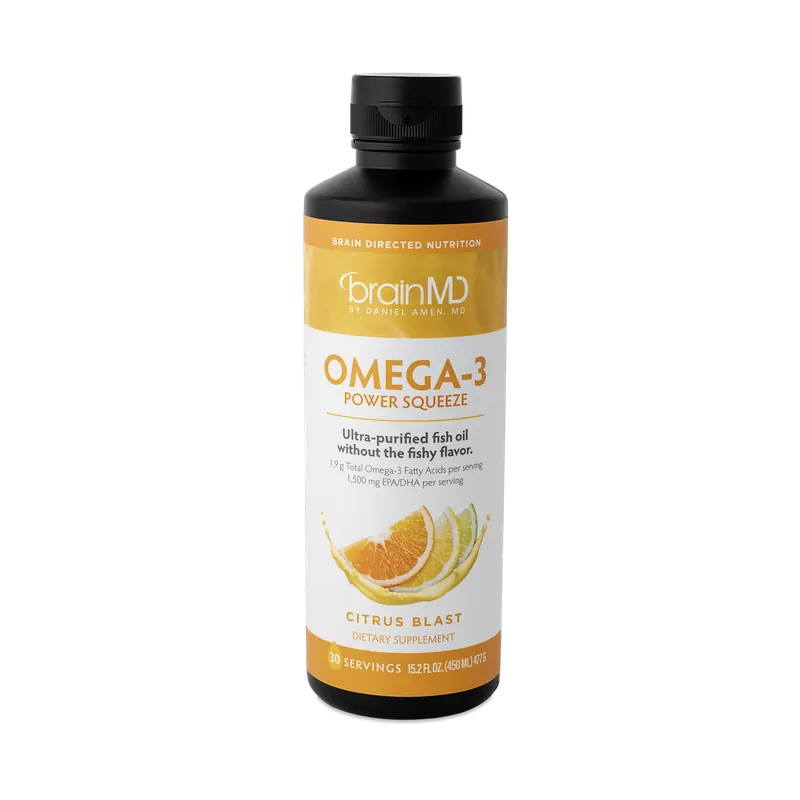
One tablespoon of citrus-flavored fish oil from a squeeze bottle, with 1,500 mg of EPA and DHA, instead of a handful of capsules.
SEE THE BOTTLE AT BRAINMDSold by BrainMD, Irvine, California · 15.2 fl oz, thirty tablespoons · shake well, refrigerate after opening, finish within 30 days · contains fish and 4 g of xylitol per tablespoon
Short Answers to the Questions I Get at the Bait Shop
Asked across the counter
Is this medicine?
No. It is a dietary supplement, and its label carries the standard sentence saying the Food and Drug Administration has not evaluated its claims.
Does it really have to go in the refrigerator?
After opening, yes, by its own label. It also asks you to finish the bottle within thirty days.
Why shake it?
It is fish oil held in water by gums, and the label asks for a shake before each use so every spoon matches the panel.
How does one spoon compare with a fish supper?
About the same EPA and DHA as three ounces of salmon or herring, and nearly twice what three ounces of rainbow trout holds. [3]
Will it help my memory?
I cannot tell you that. At this dose, the large trials in healthy older adults found nothing, and one pooled reading found a narrow signal in episodic memory. [4] [7]
Can I take half a spoon to make it last?
It will not last. The label gives it thirty days once open, so half a spoon means half a bottle left at the end.
Is the xylitol a problem?
Not for a person at four grams a spoon. For a dog it is a genuine hazard, so keep the bottle high and closed. [13]
Can I send it back?
Within sixty days, with a catch. Unopened earns the price back less shipping; opened earns store credit, and return postage is yours.
The Northern Kitchen Version, in One List
- A tall opaque bottle of emulsified, orange-flavored fish oil from BrainMD of Irvine, California, eaten by the tablespoon, thirty to the bottle.
- The label's usage line asks for one tablespoon a day with food, a shake before each use, the refrigerator after opening and a finish within thirty days.
- Thirty spoons and thirty days are the same number: skipping days or halving the spoon leaves bottle behind when the clock runs out.
- One tablespoon holds 910 milligrams of EPA and 590 of DHA, about a three-ounce portion of salmon or herring and nearly two of rainbow trout. [3]
- The oil comes from anchovy, sardine and mackerel, and federal fact sheets report that purified fish oil supplements have not been found to carry methylmercury. [3]
- Side effects of omega-3 supplements are usually mild and stomach-shaped, which is one reason the label puts the spoon beside a meal. [2]
- Three large trials at or above this dose found nothing in healthy older adults, one pooled reading found a narrow signal, and 51 trials leave the question open. [4] [5] [6] [7] [11]
- Four grams of xylitol a spoon is a genuine hazard for a dog, so the bottle lives on the top shelf with the cap closed. [13]
- Sixty days to return it, thirty days to finish it: unopened earns the price back less shipping, opened earns store credit.
- Fish twice a week, less from the bottle on the dock, less from the packaged shelf, eggs and beans, and water still belong on the table. [14] [15] [16] [17] [18]
What a Month of This Bottle Is Worth
Here is the whole thing in one breath.
An honest panel, three named fish, a dose you can check against the trials and against your own supper plate, and a label that tells you how to keep it.
Against that: large trials at this dose that found nothing in men my age, one unsourced sentence about absorption, and a thirty-day clock that punishes the man who takes it now and then.
If you are a man who rarely eats oily fish, who wants the fats of a salmon supper in a spoon he will actually take, and who has room at the back of the refrigerator, that is worth a bottle.
Not because of the stars, and not because of the front of the label.
Because you will know what the spoon holds, how it compares with the fish on your plate, and how far it sits from the studies.
If that sounds like a cool recommendation, it is meant to, and cold suits this bottle.
The warmest honest thing I can say about any supplement is that its label tells the truth and tells you how to keep it, and this one does both.
One bottle, the pharmacist first, the top shelf at the back, a shake, a spoon at supper and a date on the cap. Thirty evenings will tell you more than this page can.
One bottle, thirty evenings, a date on the cap
One tablespoon of citrus-flavored fish oil from a squeeze bottle, with 1,500 mg of EPA and DHA, instead of a handful of capsules.
SEE THE BOTTLE AT BRAINMDSold by BrainMD, Irvine, California · ships from Southern California · sixty days to return, on the terms above · keep it cold once open
P.S. If you take one thing from this page, take the refrigerator line.
Shake it, spoon it with a meal, keep it cold once open, and finish it within thirty days.
That is the label's own advice, and it is the difference between a bottle that works as a food and one that turns in the door.
P.P.S. If your memory has been bothering you for months, and it is there before the first coffee as well as after supper, talk to your own clinician before you buy anything.
A tablespoon of fish oil was never going to answer a question that a clinician answers with fifteen minutes and a few plain tests.
Sold by BrainMD · sixty-day return window on the terms above